Sebastien Page: How Introverts Rise to the Top with the One-Over-N Rule and Strategic Patience
Increase Visibility & Influence Authentically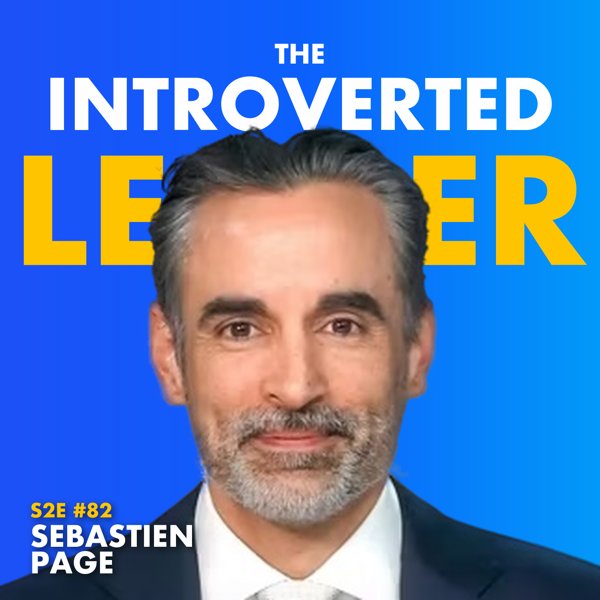
Sebastien Page is a longtime senior finance executive and author of *The Psychology of Leadership*. He built his career by pairing deep quantitative work with clear, confident communication — and he's here to bust the myth that visibility belongs to the loudest voice in the room. Greg and Sebastien dig into the research on personality and leadership, the practical mechanics of running meetings that surface quieter voices, and why strategic patience is one of the most underrated executive skills.
There is zero correlation between introversion traits and being a bad presenter.
The super skill is not talking, it's listening.
You have to realize that anger is expensive.
If you speak 50% less than what's going on in your head... the 50% you select that is worthy of you going through the discomfort of interrupting is gonna be better.
Strategic patience is greatly underrated in business because of the bias to action.
It might be harder to get the job, but once you have the job, you're gonna listen better, have more empathy — and these are the super skills of leadership.
Key Stories
- From intern to executive by combining deep analysis with clear delivery: As a young quantitative analyst, Sebastien prepared seriously for a research presentation and delivered it clearly. Once his bosses realized the deep quant work came packaged with strong communication, he was hired and quickly asked to explain difficult concepts to clients.
- The human piranha on steroids: Sebastien pairs with an extroverted salesperson colleague on client trips — the salesperson runs small talk, Sebastien delivers expertise. A working example of complementary strengths, and a template he now sees across industries.
- Rockefeller and the cost of anger: Sebastien recounts a moment from Rockefeller’s biography where, under attack, Rockefeller stayed quiet while his team clamored to fight back — then told them, “You have to realize that anger is expensive.” A study in when silence is power.
- The 80/20 media interview: After feeling talked over in a joint media interview, Sebastien fed the published transcript into AI and confirmed his colleague had taken 80% of the airtime. Data-backing what his gut already knew.
- The Muhammad Ali contrast: Greg brings in the Ali biopic — long silent training scenes cut with the witty, charismatic press-conference Ali — as a visual of how public performance is birthed in private reflection.
Techniques & Frameworks
- The One-Over-N Rule: In a meeting of N people, each person should contribute roughly 1/N of the airtime. Sebastien names it openly in his steering committees so people self-regulate — dominators catch themselves; quiet contributors know they’re expected to step up.
- The Pivot Method: When someone monopolizes, the leader (1) politely interrupts, (2) briefly summarizes what they said so they feel heard, then (3) pivots to a quieter person — often by reading body language or knowing who’s an expert on the topic.
- “How much time do we have to make this decision?”: Sebastien’s opening question for any decision on his desk. It exposes false urgency, preserves optionality, and lets strategic patience do its work — especially useful when a team is trying to hand you the monkey.
- Deliberate non-resolution of team disagreements: Instead of reflexively resolving every John-vs-Mary dispute, leave some conflicts unresolved. Teams often figure it out themselves, and you stop being the bottleneck for every decision.
- Speak 50% less than what’s in your head: For introverts in fast meetings, filter down to the most worthy point rather than trying to make every point. The signal-to-noise ratio of your contribution rises.
Full transcript
Have you ever been the smartest person in the room and still been passed over? You did the deep work. Analysis was airtight. Your recommendations flawless, but the person who talked better carried the day, and you didn’t. That’s the trap many introverts fall into. It’s believing that the work will speak for itself. Leadership communication is what turns your expertise into influence. My guest today became a senior executive in the financial industry by proving that the introvert who pairs deep analysis with clear delivery doesn’t just get seen, they rise to the top. Welcome to The Introverted Leader. It’s a podcast helping introverted leaders embrace your underrated quiet strengths so you can get promoted and start earning what you deserve. My name is Greg Weinger. I have over 25 years of leadership experience, and yes, I am an introvert. Sebastian Page is author of The Psychology of Leadership, and he’s a longtime finance executive. He’s here to personally bust the myth that visibility belongs to the loudest voice in the room. Before we start, I made a free masterclass for introverted leaders. It’s called Why Everything You’ve Been Told About Getting Ahead as an Introvert is Wrong. 30 minutes, it features the three moments that decide whether you advance or not, and a practice to start this week. Get started at gweinger.com/masterclass. That’s G-W-E-I-N-G-E-R.com/masterclass, one word. All right, let’s get into it All right, Sebastian, welcome to the show Thank you, Greg. I’ve been looking forward to this. When I was doing the research for The Psychology of Leadership, my most interesting, fun to write section was about personality, and I’ve been looking at how you talk about introversion, so I’ve been looking forward to this Yeah, absolutely. Me too. Just as someone who is a leader who’s doing it at a very high level in a big company. You’re walking the walk here, and so it’s great to have you and have your perspective, and you’re not just a practitioner. You’ve written extensively about it, so really glad to have this conversation here. Thank you, Greg So, for the record, the official record, do you consider yourself an introvert, extrovert, or other? I’m an introvert fundamentally. I took a few personality tests and it comes out pretty strongly. I will maybe behave differently in different situations, but fundamentally I’m just wired as an introvert Yeah. Yeah, well, you’re in good company here. So you started out your career as a quantitative analyst, and as a profession, you’re rewarded for deep thinking, probably do your best thinking on your own, and then your performance isn’t measured at all by how much you talk in meetings, that kind of thing. Maybe take us back to that version of yourself and, at the outset, what did you think about leadership? What did that mean to you? You know, I think there’s a bit of a myth here that leadership is harder for introverts or not as natural, and I’m sure we’ll get into this, Greg, but I had leadership abilities and communication abilities starting in the early days of my career. It’s not something that I’ve had to build or develop. I’ve had to improve it, but I had some of this. I was doing deep work, coding, quantitative analysis, and however, there was a pivotal moment where I was asked to present my research. And as an introvert, to me, I decided to prepare seriously for it, and I delivered a strong, clear, well-thought-out presentation. And this is a myth also about introversion, is that introverts are not good presenters. That’s not true at all, and you see it all the time. I present now three or four times a week for my day job in front of crowds, Mhm. and I’m good at it. So that was an important moment for me, though, in my career because as a quant analyst, when my colleagues and importantly my bosses realized that I could communicate clearly and well Then the combination of deep skills, quantitative, and the ability to communicate it became really an attractive package for the firm, and I got— I was an intern at the time. I got a job offer, and soon enough, I was asked to explain difficult quantitative concepts to clients. And that’s how I built the first few years of my career by combining these things. And I wanna say one thing about this, Greg. This is about teamwork. I am clearly not wired for sales. You know, if I’m on the plane on a way somewhere and I’m with a salesperson, it’s always interesting to see how they chat with everybody around them, clearly extroverted. They’re bored, so they’ll start a con- strike a conversation. I’m on the plane, I put my Bose headphones, and I look down at my book. mhm g-going back to your beginning, shyness in- not an inherent, fact of introversion, and so there are many introverts who, similar to you, have a lot of comfort stepping into the limelight, and there’s many more who feel some discomfort but actually really enjoy, stepping into presenting and that kind of thing. That’s something I also realized early on was a talent for me, but, I would get butterflies, a little bit. So I had just a little bit of that, but I still did it anyway because I just enjoyed it so much. Collaboration absolutely too is another really key. That’s kind of a superpower, I think, of introverts. We’re able to form these relationships and, get that kind of a synergy going with people who are extroverts because, your combined powers, you can accomplish a lot together. That’s a great, lived example of that. And Greg, this happens across industries. An expert travels with a salesperson to present to clients and prospects. The salesperson does all the small talk. The expert is in their head most of that time, and then we sit down with a client, and expertise is delivered in a professional, confident way. And it just works really well. This is not just money management. It’s engineering. It’s any industry that needs to grow to reach out to understand their clients and deliver expertise. Even when we hire business consultants, I see it. I see the analysts and the salesperson and the team working together, and it works well. So for me, that person that launched it for me was a legend at the company. I didn’t know what I was up for. I mean, he didn’t swear just a little bit. It was almost like an act, right? He actually was a really nice person. Угу giving him a nickname in the book because I didn’t want to use his real name. There’s a famous finance book by Michael Lewis about Wall Street, where he describes a human piranha who’s so aggressive and swears so much. So in the book, my salesperson, my colleague, ended up being the human piranha on steroids. And, it’s an accurate analogy, I will say, about how he was on the road and how we worked together. And it was wonderful. So I learned early how to work as a team and the one thing I wanna also draw out for the audience is that this is authentic leadership for you. So when you’re coming in, you’re relying on your strength, You’re not, pretending to be anything else. You can actually really lean into your strengths as an introvert. You know, pair yourself with an extrovert to handle some of those other, situations, and, you’re each kind of bringing, what’s authentically yours to that situation. And I think it’s not just sales. I think it’s business in general, even working in different teams. You will have people who will build relationships with you that they will realize that their skills are complementary, and working together on projects, they might speak up early, establish the contact in a meeting, and then turn it over to you. It’s not just about specific sales situation. This myth that introverts are not good presenter, I think we have to do away with that completely. It might be, to your point earlier, a point of discomfort to get up on stage, but the level of preparation and the verbal skills, there is zero… you know how Susan Cain said there’s zero correlation between being the best talker and having the best idea? I’m gonna say there’s zero correlation between introversion traits and, being a bad presenter Yeah, absolutely. Totally agree with that Now, I don’t wanna come across as tooting my own horn and saying I’m a great presenter. Like, I struggle with everybody sometimes, and some days I’m not on. But my general point is, there’s so many myths about introversion. That’s why I’ve been looking forward to talking about this with you. The idea that, you know, we’re shy, that we’re not good presenters. But all that being said, Greg, there is some data that correlates personality traits with both leadership ascension, so getting a promotion into a leadership role, and leadership effectiveness once you’re in a leadership role. If you look at the five personality traits, extroversion, conscientiousness, openness to experience, neuroticism, and, agreeableness, there are three of them that are correlated with leadership success. Extroversion empirically is. Conscientiousness is. Now, if you wanna get the job, the top job, you’re gonna have to be conscientious, show up on time, be organized, deliver on your promises, work hard. And openness to experience and ideas, that for a leader is important because leaders are often asked to drive change. It’s one of the key jobs of a leader. So out of those, you have these three traits that correlate with leadership ascension. But now we know from Susan Cain’s book and from other sources that leadership effectiveness— Actually, introverts can have an edge. You know, it might be harder to get the job, but once you have the job, you’re gonna listen better, have more empathy, and these are the super skills of leadership. This I’ve learned recently in my career. I’ve climbed the ladder my entire career, but recently, last three, four, five years, I’ve realized the super skill is not talking, it’s listening. mm-hmm. At the very high levels of leadership, you perform best when you listen because you have smart, ambitious, driven people around you, and you’re actually projecting power and making wiser decisions by being a better listener. Who does that better typically? Introverts, not extroverts. And That’s gotta be tied into openness of experience. You’re not taking in that experience if you’re not listening. And so you don’t take in the full range of what’s perceivable if you’re not really doing a lot of listening. Yeah. And you know, when you look at it, a lot of titans of industry, of sports are introverts. I’m sure you’ve talked about that over time on your show, but, you know, Rockefeller in the late 1800s, one of the richest men in history, was quiet. You know, I read his biography and then did a little bit of research about how people interpreted his personality. There’s a scene in his story where Standard Oil is under attack. You know? It’s a monopoly. Politicians are coming for them. Competitors are coming for them. Rockefeller’s there with his leadership team. Everybody is agitated. Everybody’s talking. “We’re gonna do a counter lawsuit. We’re gonna do this PR campaign. We’re gonna fight back.” And frustratingly for them, Rockefeller’s pretty quiet. And as they walk out of the meeting, someone asks him, like, “Why so quiet? Don’t we need to fight back?” And he famously said, “You have to realize that anger is expensive.” Right? This is one of the big money men of history who’s looking at the cost of anger. Mm-hmm. That’s a great quote But he was famously quiet, and when he spoke up, people listened. It’s interesting, in meetings you see sometimes the quiet ones that will actually speak softly but make their words count wield more power than those that just talk and talk and talk and listen to themselves talking, and there’s nothing wrong with that, by the way. I don’t think extroverts are jerks and introverts are all nice people that, you know, if we could just let them talk, they would be wonderful. I don’t think we wanna stereotype that way. It’s just people are just communicating differently and experiencing the social interactions differently Yeah. And they bring different contributions, to the meeting. It’s— I think evolution has, solved for, has optimized for having both types of personalities. Having, the people who are constantly thinking and moving, biased towards action and, ready for anything, and then, the people kind of stepping back and reflecting. And I love to see you observing that and, creating a thriving atmosphere in these corporate situations. Well, let’s talk about that for a little bit because that can be difficult when you have introverts and extroverts working together. We all know that extroverts get energy from the meeting, they get energy from the interaction, and it’s a bit draining for introverts even though both might be as thoughtful and perform as well in the discussion as each other What happens almost all the time in business meetings, of course, is that the extroverts take more airtime. I explain in The Psychology of Leadership that in my steering committee meetings, I use a one over N rule. You introduced the podcast by mentioning that I was a quantitative analyst, so one over N. the formula here. N as in Nancy is the number of people in the meeting. This is unusual because it’s a podcast, so I’m called upon to talk more, but there’s two of us, so N equals two. People should, between the two of us, contribute 50%, one over two. If there’s 10 people, then everybody should contribute one over 10. That’s 10% of the contribution. It’s not a hard rule, but it’s a shorthand to say, “Hey, if you’re not participating as much as you could or should, make a little bit of an effort to step up. And if you’re just listening to yourself talk and there’s 10 of us and you’re monopolizing 90% of the conversation, just scroll it back.” Mhm. That one over N rule is something we discuss openly, and when someone goes on and on and on in my meetings, they’ll probably stop themselves, I hear it all the time, and say, “Sorry, I know I’m violating the one over N rule.” You know? So they’ll acknowledge it at least. And so as the leader, the person running the meeting, what do you do about that? I’ve used what I call the pivot method. It’s simple and effective. If someone’s dominating and not contributing Proportionally to the amount of airtime that they’re taking. I will politely interrupt, and there’s— It’s not always easy, but it’s important when you do to be polite. “Sorry about that. I apologize.” Just a little verbal mark of respect. Next, what you wanna do is summarize the points that the person was making. That’s critical because they will feel heard. “So Greg, sorry for interrupting. I think you’re right. This podcast, is introducing new ways we should think about personality psych.” Whatever you were talking, right? Mhm. And then is the pivot. So polite, summarize, pivot, and now you go to a person who’s been quiet. There’s an art to this. You need to read the body language. Over time, if you spend a lot of your time in meetings, you’ll see when people are ready to talk. They’ll send all sorts of body language signals. This is why Zoom meetings aren’t as effective as in-person meeting. Many reasons, but this is one of the reasons. So you can pick up and you can say, “John, what do you think?” Because you picked up on the or you know, you get to know people, you know that they’re an expert in that area. So now you’ve successfully pivoted. You’re conducting the meeting in a way that draws in the introverts. And the reality is most introverts, at least in my experience, I don’t have research for this, under-contribute versus what they could just because, you know, extroverts just take the airtime. So the pivot is wonderful. It works really well. It’s practical. It’s simple. Just be polite, summarize, pivot And just to draw it out and the formula kind of puts it in relief who, really there should be equal contributions from everybody, and you can set that expectation as a leader. And part of me was wondering, you could probably ask Gemini for a quick percentage breakdown for the attendees in the meeting. And also is probably a good heuristic about making sure there’s not too many people in the meeting, because if it’s not realistic for everyone to meaningfully contribute, why are they there? I got an anecdote about this. I was called upon with a colleague/competitor from somewhere else in the industry to do media together. And we did this interview, and I felt frustrated in the interview because I felt like it wasn’t one over N. There was a massive contribution from his side, and it was an important interview ‘cause it was gonna be published. And I sort of caught myself thinking, “Am I wrong here?” So when the interview got published as a Q&A, I put it in AI, and I asked how much each of us talked. And it was very clear it was 80%/20%. So it wasn’t just my impression. The AI just counted the words. There’s a lot that AI can do that we don’t even know yet, and I do think it can help us run meetings. And again, since we’re busting myths about introversion, this idea that introverts don’t enjoy being with other people or don’t like people is just a myth. Mhm But this idea that you’re introverted so you don’t really like being with people or you don’t really like people is a complete myth. Do you agree, Greg? Oh, yeah. Yeah, absolutely. I mean, I think the introverts I know and the way I am is it’s really about, we’re really good at building one-on-one relationships, and we have the most comfort there or in small groups. And it’s really only when you get to larger groups, it varies for people, five, six or more, four, five, six, wherever it is for you, the dynamic changes, and it becomes more difficult to know what to do. Actually, that’s something I wanted to ask you about because, as a leader, experienced as you are at your level, I find personally very challenging is in large group, settings, I have a point to make, and, it’s appropriate in that moment. And we’ve got some extroverted leader, using airtime maybe more than their one over N, by the time I have a chance to break in, the conversation has either shifted I find it challenging to maintain the point that I have but also giving its due because I wanna stay involved and grounded in the moment also. So I’m curious how you approach those situations. It’s frustrating when you had such a good point, but the discussion moved on, and now it’s too late, right? Or you have to bring the conversation back to five minutes ago. I think what you bring up here is super important because we’ve been talking about how it’s the responsibility of the chair, the leader, to manage the meeting in a way that calls on introverts. It’s one of the principles in The Psychology of Leadership, call on the introverts. But Greg, what you’re saying is, as an introverted person in a meeting, a lot of it is also on us to learn to speak up, to learn when to speak up, how to speak up, and to go through the discomfort of interrupting and speaking up. There’s no secret recipe, It’s like a lot of things in life, the more you do it, the more you improve and get better at it. It’s a lot of reading the body language. Again, being in a meeting in person. However, with a lot of virtual meetings nowadays, there’s a wonderful raise your hand button on Zoom that for introverts, like you’re not interrupting, you’re just raising the hand, and now it’s on the screen, and now you’re gonna get called on. I wish we had something like that for in-person meetings, right? It’s like when I go to the, Brazilian steakhouse, and there’s a green side of the, thing on the table and a red side. I don’t know if you’ve ever been to a Brazilian steakhouse. But once you… If you put the green, part up, they just bring you meat. They just bring you food. And, and if you put the red, it just says, “Okay, give me a break. Like, don’t…” So if there was something like that… i’m just brainstorming with you and our audience here. But if there was something like that in meetings where you can just say like, “Hey,” you know. And that’s why in school you raise your hand, but in corporate meetings it might look a little odd. But look, I’m just gonna say this for all our audience. Just go for it. You know, learn to live with the discomfort. It’s not natural, but to your earlier point, Greg, that’s part of life, right? It’s not just about everything being easy and having positive emotions all day long. That’s not the human condition. And so you have to go for it and interrupt. The reality, is that if you speak 50% less than what’s going on in your head, not every point that you wanna make, you need to make, the 50% you select that is worthy of you going through the discomfort of interrupting is gonna be better. We all need to filter down. Yeah. Yep So, you know, it’s okay to pass, but again, I just circle back to the idea that it’s incumbent upon the person themselves, the introverted person, and also the chair of the meeting. And I gotta say, I run meetings every day. We tend to forget that rule of calling on the introvert. We tend to get in the flow of discussion, and we forget. It’s easy to forget to do that Yeah. Even as an introvert, we know all these things and it’s easy to get caught up in it. Yeah. I’d be the first to admit that. So it’s a challenging and it’s a discipline to remember that, but it is good leadership and good, meeting hygiene, I guess. And you know, Greg, I was preparing for a discussion and I looked up a list of famous introverts just to make the point that it’s not shyness, it’s not lack of presentation skills, it’s not lack of confidence. This is a list of people who either self-report as introverts or that are widely accepted as being introverted. I don’t know if you’ve looked at these lists before, but Mhm. Warren Buffett, Bill Gates, Tim Cook, Satya Nadella, basically some of the best leaders of our modern times. Barack Obama. In sports, Roger Federer, Lionel Messi. So do… You know, let’s do away with those myth about shyness and lack of confidence, or just lack of performance in general Right. Or this idea that there aren’t introverted leaders, you know? Yes, exactly some of our best… it goes back in history, like, Abraham Lincoln is one of my Yeah Eleanor Roosevelt, spiritual leaders, Martin Luther King, Gandhi. Martin Luther King is an fascinating example too because, like one of the greatest orators, Yes There’s a scene from the movie “Muhammad Ali,” with, Will Smith, it was brilliant ‘cause it’s just like extended scenes of him, training, like jumping rope, and then, all the bags and all the different things he does and just quiet, like just music, him, it’s just internally in his head. then they cut to the scene of which we all remember is, he puts on a performance. Like he’s witty, he’s saying all these things and, he’s the charismatic Ali that we know. it’s like the shift, the juxtaposition is so powerful because it shows how much of that was birthed in silence essentially, in his self-reflection. And those two parts of his personality were kind of, revealed in that. Yeah, I think that’s a great example with Muhammad Ali. I write about strategic patience. There is this idea in business that we need to make quick decisions and be quick on our feet. Mm-hmm And typically, if you’re extroverted, you’re gonna tend to be vocal and maybe, have a tendency to make quicker decisions. You might lack the interest or ability for deep work and thoughtful consideration. It turns out in business, it’s an underrated skill that strategic patience is really rare and needed. Not in all situations. There are lots of situations where you need to make quick decisions. But I see an edge for introverts on strategic patience just because of the process of taking in all the information and being thoughtful about the decision-making process. If you have time to make a decision, why rush? Keep the optionality. I’ve seen great leaders do this. If you have six months to hire someone ‘cause someone else is retiring, take the time. You’re more likely to find a better candidate if you interview more and take the time to deliberate and get feedback from others. If you’re looking for an apartment and you don’t need to move for the next six months, visit more apartments. But what happens in business is we just wanna get it done. And so strategic patience is greatly underrated, and I think there’s a little edge here for introverts I’m pretty vocal about this too, because what I see is that people fool themselves I think there’s a need for certainty and, I think there’s kind of a dopamine rush of making quick decisions, and then it’s easy to develop this belief that, “Oh, I’m really good at quick decisions.” And so I see people, leaping to make decisions when you could have taken a couple hours to go back and get the data. You could have taken a couple of days or even a couple of weeks, but you rushed a decision and it wasn’t an optimal decision. And that’s where I’ve personally a lot more vocal about, “Hey, we don’t need to make a fast decision here. Let’s grab the data. Let’s do an analysis.” it isn’t analysis paralysis. It’s, taking the time that you really have. I think it’s kind of what you said. Yeah, and the psychology of leadership, I call it strategic patience, and I argue it’s greatly underrated in business because of the bias to action. My conclusion is that it’s a skill you can develop, and there’s a really underestimated aspect of this, which is that as a leader, a lot of decisions you have to make come down to resolving disagreements between members of your team. John wants to do A, Mary wants to do B. They come to you, the leader, to resolve the question. If you lack strategic patience, you’re gonna have a reflex to resolve these issues, these conflicts all the time, quickly. You’re actually creating a dependence on your team so that you’re always need to be there to resolve these conflicts or these disagreements. Strategic patience might mean not to resolve it, and what you’ll find out is that when you do that, in some situations, people figure it out amongst themselves. Greatly underappreciated aspect of strategic patience, which by the way, is a huge part of leadership, just resolving disagreements. Mhm. Now, sometimes you need to. I mean, you can’t just say, “Okay, I’m not gonna be involved. You all sort it out amongst yourselves.” You’ll know when you need to step in, and, there’s gonna be winners and losers, and it’s hard, and that’s why you make the big bucks as a leader, as they say. Yeah Do you have an example of something you use maybe a mini script for, what comes to mind is, let me think about this, but how do you say that in a way that kind of puts it back on the team maybe it’s we don’t need to make a decision on this right now. Continue to work on this and see what you come up with. I start with a question which is not often asked but should be asked: How much time do we have to make this decision? Simple question. Mhm. And then you’ll see people step back sometimes, right? ‘Cause they want an answer right now, but they know very well that it’s not urgent. They don’t need the answer right now. They’re just trying to put the monkey on your back. They’re just trying to relieve that. How much time do we have to make this decision? That’s how you start. And then, yes, Greg, you can just say, “Well, let’s take the time we have.” It becomes clear that optionality is something you should keep. Look, it’s, it’s mathematically true that time is to your advantage and that your standards should be higher the more time you have In your experience, you’ve seen, this ability for, introverted leaders to outperform and display some of these skills. have you seen this also in studies and literature? Oh, yeah. There’s plenty of data, especially once you’re in role, that shows that introverted leaders perform quite well and, in some studies, better than extroverted leaders. There is data behind this. And by the way, if even for leadership ascension, I, I mentioned three traits that positively correlate with getting a leadership job: extroversion, conscientiousness, openness to experience. Those correlations are not very high. They’re only 30%. So there are lots of other factors, you know. Don’t think that this is that limiting. There’s a lot of noise, a lot of other factors in the data. Yeah. This has been such a great conversation, Sebastian. I know our time is drawing near. I’d like to give you a chance if people wanna learn more about you and your work and your book, where should they go? They can find me on LinkedIn, very easy to find there, on Substack, and you can find The Psychology of Leadership, best way to buy it is on Amazon Yeah. Sebastian Page. search for that. Fantastic. Sebastian, so great to have you on the show. Thanks so much for being here today. Thank you, Greg Okay, one clear takeaway from this conversation is just how strongly Sebastian pushes back against this idea, this myth, that introverts don’t belong in leadership. He’s living proof, as am I. Three things to take away. Number one, Sebastian’s career was built on pairing deep analytical work with this ability to communicate it very clearly. It’s a one-two punch. Your expertise on its own isn’t enough, but expertise paired with clear communication, now that’s leadership Number two, the one over N rule. If there are 10 people in a room, each person should contribute about the same amount of time. When someone dominates, the leader’s job is to politely interrupt, summarize what they said, and then pivot to a quieter peer. It’s simple, practical, and it works. And then number three, practice strategic presence. Before you rush to make a decision, use the question Sebastian asks: How much time do we have to make this decision? Preserving optionality is a strong leadership skill. Deliberation isn’t weakness, it’s an edge. And if you like this content, here’s one more edge for you. Join my free masterclass. It’s called Why Everything You’ve Been Told About Getting Ahead as an Introvert Is Wrong. 30 minutes, three moments decide whether you get promoted or stay where you are, and a practice you can start this week. Get started at gweinger.com/masterclass. That’s G-W-E-I-N-G-E-R .com/masterclass. That’s one word. I’m Greg Weinger. Keep leading with quiet confidence, and I’ll see you next time