Mindfulness at Work: Lead With Quiet Authority (Without Burning Out)
Manage Your Energy & Thrive in Extroverted Cultures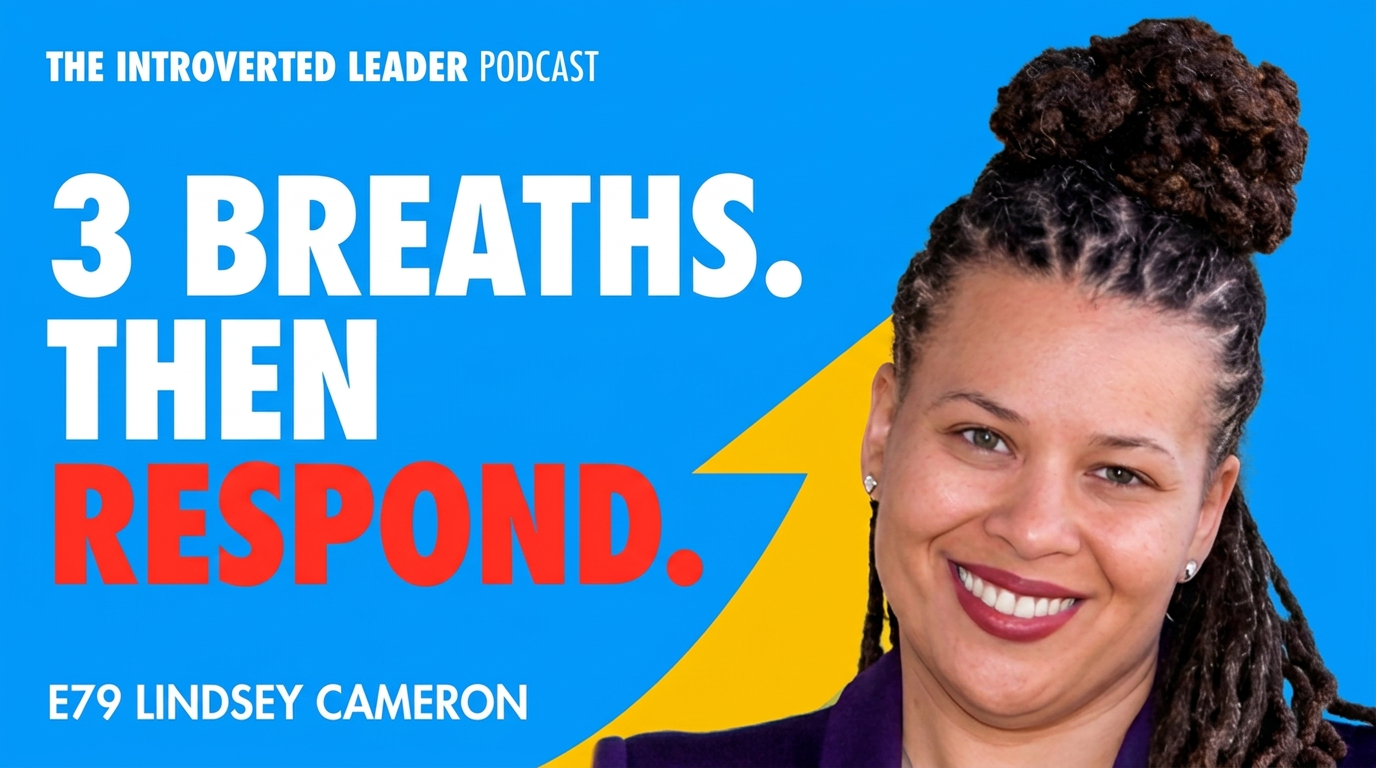
Lindsey Cameron is a Wharton management professor whose career began in the intelligence community doing counterterrorism work, including in Baghdad, before she left for a PhD and became one of the leading qualitative researchers on gig work and algorithmic management. She opens by describing herself as "an introvert who pretends to be an extrovert and then runs home and takes naps," and the conversation moves across three connected territories: a 20-year contemplative practice that began on a bulletin board in a war zone; her research on what algorithmic management and remote work quietly cost the people who like them most; and an unusually concrete set of energy-management practices, including a weekly two-hour rest group. Her sharpest warning for this audience is the "good bad job" — arrangements that feel great to introverts in the short term while removing the visibility and early-career learning that promotions actually depend on.
An introvert who pretends to be an extrovert and then runs home and takes naps.
Work is a form of worship.
You can't ask leniency from an algorithm in the same way you can ask for leniency from your boss.
Either you leave high school and you feel like you belong and you matter, or you spend the rest of your life searching.
You can love your work — your work likely will not love you back. At least not all the time.
There's a way it might feel good in the short term… but you're embedded in this bigger system where there are repercussions.
One of the hardest things in your adult life is to make new friends.
It's building the capacity for deep intimacy. And that's ultimately what we all long for.
I hadn't been read to since I was probably five. It is so soothing.
The best way to be at a party was to be the host, because you have a role.
Key Stories
- Meditation in Baghdad: Signs on the wall said stressed out? of course you’re stressed out, you’re in Baghdad and pointed to a sitting circle or a knitting group. That after-dinner hour became her entry point; she learned the rest from the back pages of Yoga Journal, then went to 3-, 5-, 10-, and 14-day retreats once home.
- The scholarship that routed her into intelligence: At the Texas Academy of Math and Science someone told her she seemed smart and should apply. It paid for undergrad against roughly six years of service — a military-style work scholarship, which is how she ended up in government at all.
- Her mother’s downward mobility: After the Great Recession her mother — who had run a successful back-end call center fixing ATMs — sold samples in grocery stores, stocked a warehouse at night, and sold purses, earning less than Lindsey’s graduate stipend while carrying herself as middle class throughout. That became the seed of her research on downward mobility.
- Driving for Uber herself: She drove part-time across three years and had research assistants drive in other cities (including a man, to compare experiences), and has interviewed drivers in eight or nine countries over a decade.
- The doctor with poor bedside manner: One driver she interviewed was a physician at a prestigious hospital who drove for Uber specifically because his evaluations flagged his bedside manner and he was trying to practice.
- Eleanor Roosevelt in third grade: Returning to her K–8 school on the South Side of Chicago after college, a teacher reflected back that Lindsey had spent an entire book report on Eleanor Roosevelt — someone the class had never covered.
- Her grandmother, born 1909: Horse carriages in the Deep South until about 1930, and airplane travel later in the same life.
Techniques & Frameworks
- The mindful moment as a doorway: In her call-center study, agents took three breaths before answering each incoming call. An acupuncturist she cites used his hand on the doorknob as the trigger. The anchor can be anything repeatable — the point is the threshold.
- From tool to way of being: Most practices start as emotional regulation — widening the gap between stimulus and response — and at some point stop being a technique and become integrated. Her sign reads “work is a form of worship.”
- The good bad job: Gig work and remote work both offer real short-term goods — flexibility, fewer microaggressions, control over earnings. The cost is opacity about the rules and the loss of face time, sticky relationships, and early-career learning that promotion depends on. Research shows introverts, people of color, women, and LGBT people prefer remote work — which is exactly why the tradeoff matters for this audience.
- You can’t ask an algorithm for leniency: The appeal of not answering to a human boss is real, and so is the loss of the discretion a human manager could exercise.
- Ancestors as a source of wellness: Not only blood relations — Lindsey counts Marie Curie, Eleanor Roosevelt, and Ida B. Wells among the lineages she draws on.
- Build a refuge outside work: “Your work likely will not love you back.” She keeps distinct crews — workout, meditation, gardening — and organizes retreats four or five times a year with them.
- Small, slow community-building: Friendship takes many accumulated hours, and she isn’t making ten new best friends at a party. Long retreats and structured relating circles (her “art of living relationships” groups) build depth faster than small talk.
- The rest group: Two hours, once a week, mid-workday, on Zoom, with an annual in-person retreat. Members take turns facilitating — guided meditation, music, a lecture on the science of rest, or simply being read aloud to.
- No-input commuting: She walks or bikes to work with no podcasts and no music. At home, mantras at most; every lamp holds a white bulb and a red bulb, and the house goes red after sundown.
- Tea ceremony two or three times a week: Loose leaf, set table, a flower, soft music, sometimes a candle, clockwise pour — a smaller version runs in her office.